
Project brief
Paracel Cellulose Plant
Paracel is advancing a cellulose plant and forestry-industrial platform in Concepcion, backed by corporate sources and multilateral financing documentation. The investment scale and site are well documented, while the commercial operation date remains tied to construction progress.
Last reviewed: July 13, 2026
Project, salary and exchange-rate data checked against primary sources (official company announcements, IDB Invest, BCP). Legal requirements are reviewed semi-annually; always confirm with the official source.
- Source: Agencia IP — Paracel construction progress
- Last verified: May 01, 2026
- Confidence: high
- Paracel, IDB Invest, and Agencia IP cite around 7,000 direct and indirect jobs during construction and a larger long-term impact, but they do not publish a stable category-level breakdown for this page.
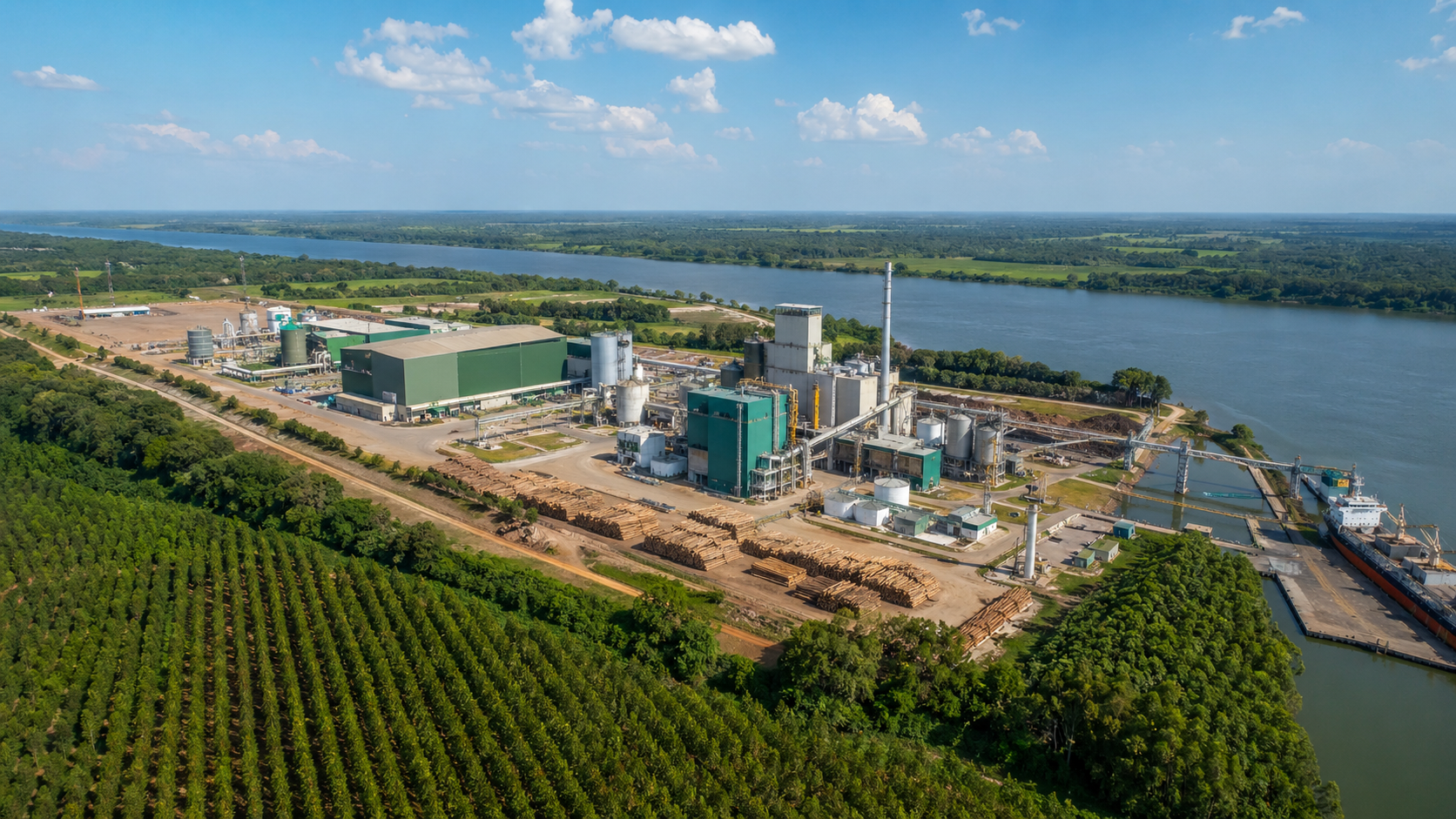
Paracel is advancing a cellulose plant and forestry-industrial platform in Concepcion, backed by corporate sources and multilateral financing documentation. The investment scale and site are well documented, while the commercial operation date remains tied to construction progress.
This brief highlights the most probable industrial profiles: process operations, mechanical maintenance, welding, electrical work, environmental compliance, and ESG reporting.
If you are making training or relocation decisions, use this page together with official project communications. It is not a promise of immediate hiring.
Paracel Cellulose Plant
Project Overview
The Paracel cellulose complex in Concepción, Paraguay, represents the single largest industrial investment in the country’s recorded history. The project, currently under construction with an announced investment exceeding USD 4 billion — with some analyst coverage citing figures up to USD 5 billion depending on ultimate project scope — will produce bleached hardwood kraft pulp for export, targeting primarily European and Asian paper markets. Construction commenced in 2023, with an announced operational target of 2027, though timelines of this magnitude should be treated as planning objectives subject to construction and regulatory progress.
Paracel S.A. is the primary project vehicle. Its corporate backing includes Heinzel Holding, an Austrian paper and pulp group; Girindus Investments; and the Paraguayan business group Zapag. The multilateral finance architecture — which includes IDB Invest (the private sector investment arm of the Inter-American Development Bank) and the International Finance Corporation (IFC, the private investment arm of the World Bank Group) — reflects the degree of institutional due diligence applied to a project of this scale. Multilateral backing of this nature typically indicates that environmental, social, and governance (ESG) documentation, labor standards, and community impact assessments have undergone independent review, a factor relevant to international professionals considering long-term affiliation with the project.
Strategic Significance and Logistics Advantage
Concepción’s position along the Paraguay River corridor is central to the project’s logistics rationale. The Paraguay-Paraná Hidrovía (the inland waterway connecting Paraguay to the Río de la Plata estuary and Atlantic shipping lanes) enables cost-competitive bulk export of pulp bales without dependence on overland routes to Pacific or Atlantic ports — a constraint that has historically limited industrial-scale investment in landlocked South American countries.
Paraguay’s plantation forestry base, developed over the past two decades primarily with eucalyptus and pine, provides the upstream fiber input. The country’s relatively low land costs and available forestry concessions have made the economics of a greenfield pulp operation viable in a way that would be difficult to replicate in more developed markets. The Itaipú Binacional hydroelectric surplus, which provides industrial electricity at competitive rates, further supports energy-intensive pulping and chemical recovery processes.
The scale of the Paracel facility, measured in annual pulp production capacity, positions it among the significant pulp mills in the Southern Cone region. Comparable facilities in Brazil, Chile, and Uruguay have served as reference points for Paracel’s engineering and operational planning — a point of relevance to professionals with experience at those installations.
Employment and Talent Demand
Paracel and its backers, including Agencia IP (Agencia de Inversiones del Paraguay, the national investment promotion agency), have projected approximately 7,000 direct and indirect jobs across the construction phase and long-term operations. This figure is per project communications and multilateral lender documentation; a stable breakdown by category, skill level, or nationality has not been publicly confirmed, and professionals should treat the aggregate number as a high-level planning estimate.
The distinction between construction-phase and operational-phase demand is material for career planning. Construction employment is concentrated, intensive, and temporary — typically highest in the twelve to thirty-six months before commissioning. Operational employment at a pulp mill of this scale is more stable but smaller in headcount, weighted toward process engineers, maintenance technicians, and environmental compliance staff.
Engineering and Process Roles
Pulp and paper process engineers — particularly those with kraft process experience, chemical recovery (including lime kiln and causticizing systems), and fiber line optimization — represent a profile that Paraguay cannot fully source domestically. This shortage creates a genuine opening for engineers with South American regional experience, particularly those from Brazil, Chile, or Uruguay with Portuguese or Spanish language capability.
Mechanical maintenance engineers with experience in rotating equipment (pumps, agitators, compressors) and precision alignment at large industrial facilities are a persistent demand category during both commissioning and steady-state operations. Instrumentation and control engineers familiar with distributed control systems (DCS) are similarly valued at this stage of project development.
ESG and environmental analysts with experience in pulp mill environmental permitting — including effluent treatment, air emissions monitoring, and biodiversity impact assessment — will be relevant throughout the project lifecycle. Multilateral finance standards (IFC Performance Standards, Equator Principles) require ongoing environmental and social monitoring, which supports sustained demand for qualified environmental professionals.
Trades and Construction
Industrial welders certified to ASME (American Society of Mechanical Engineers) or equivalent standards for pressure vessels and piping systems are required during construction and will remain relevant during scheduled maintenance shutdowns. Industrial electricians with high-voltage and medium-voltage switchgear experience are consistently difficult to source locally. Scaffolding supervisors and rigging specialists with large-plant construction experience are also in demand during the construction phase.
International Talent Pathway
The professional profile most likely to find direct and sustained opportunity at Paracel is an engineer with five or more years of experience at an operating pulp or paper facility in Brazil, Chile, Uruguay, or Argentina. The MERCOSUR (Mercado Común del Sur — the South American common market) residency framework provides a documented pathway for nationals of member states to establish temporary and permanent residency in Paraguay with simplified documentation requirements, an operational advantage for professionals from those countries.
Non-MERCOSUR nationals with relevant specialist experience — hydrogen process engineers, for example, are not relevant here, but chemical engineers with kraft pulp backgrounds are — can pursue standard permanent residency, which typically involves a six- to twelve-month process with qualified immigration counsel.
Hiring at Paracel and comparable facilities proceeds in layers: Paracel S.A. directly for senior and specialized roles; EPC contractors for construction trades and site management; and local subcontractors for general labor and logistics. Professionals seeking engagement should research the primary EPC contractors affiliated with the project through public procurement records and industry news sources.
Data Note
The investment range of USD 4 billion to USD 5 billion reflects variation in scope definition and reporting source rather than project instability; the lower figure aligns with IDB Invest and IFC documentation, while higher estimates incorporate additional downstream infrastructure. Both figures should be treated as announced and have not been independently audited for this publication.
Construction progress as of early 2026 has been reported in trade publications and Paraguayan press; the 2027 operational target is a project objective, not a guarantee. Professionals should verify current construction status and hiring activity through direct engagement with Paracel S.A., EPC contractors, or Agencia IP before making relocation or career decisions.
Information current to early 2026. Investment figures are announced per project and multilateral lender communications. This page does not constitute legal, tax, or employment advice.