
Project brief
ATOME Green Hydrogen Paraguay
ATOME is developing a low-emission fertilizer plant in Villeta based on green hydrogen. Publicly verifiable information places the project near the Paraguay River logistics corridor and links it to international financing confirmed in 2026.
Last reviewed: July 13, 2026
Project, salary and exchange-rate data checked against primary sources (official company announcements, IDB Invest, BCP). Legal requirements are reviewed semi-annually; always confirm with the official source.
- Source: IFC — financing for ATOME green plant in Villeta
- Last verified: Jul 13, 2026
- Confidence: high
- ATOME, IFC, and EIB have communicated 1,265 direct construction jobs and more than 5,000 direct and indirect jobs across the project cycle. This page does not distribute that total by role without a stable public breakdown.
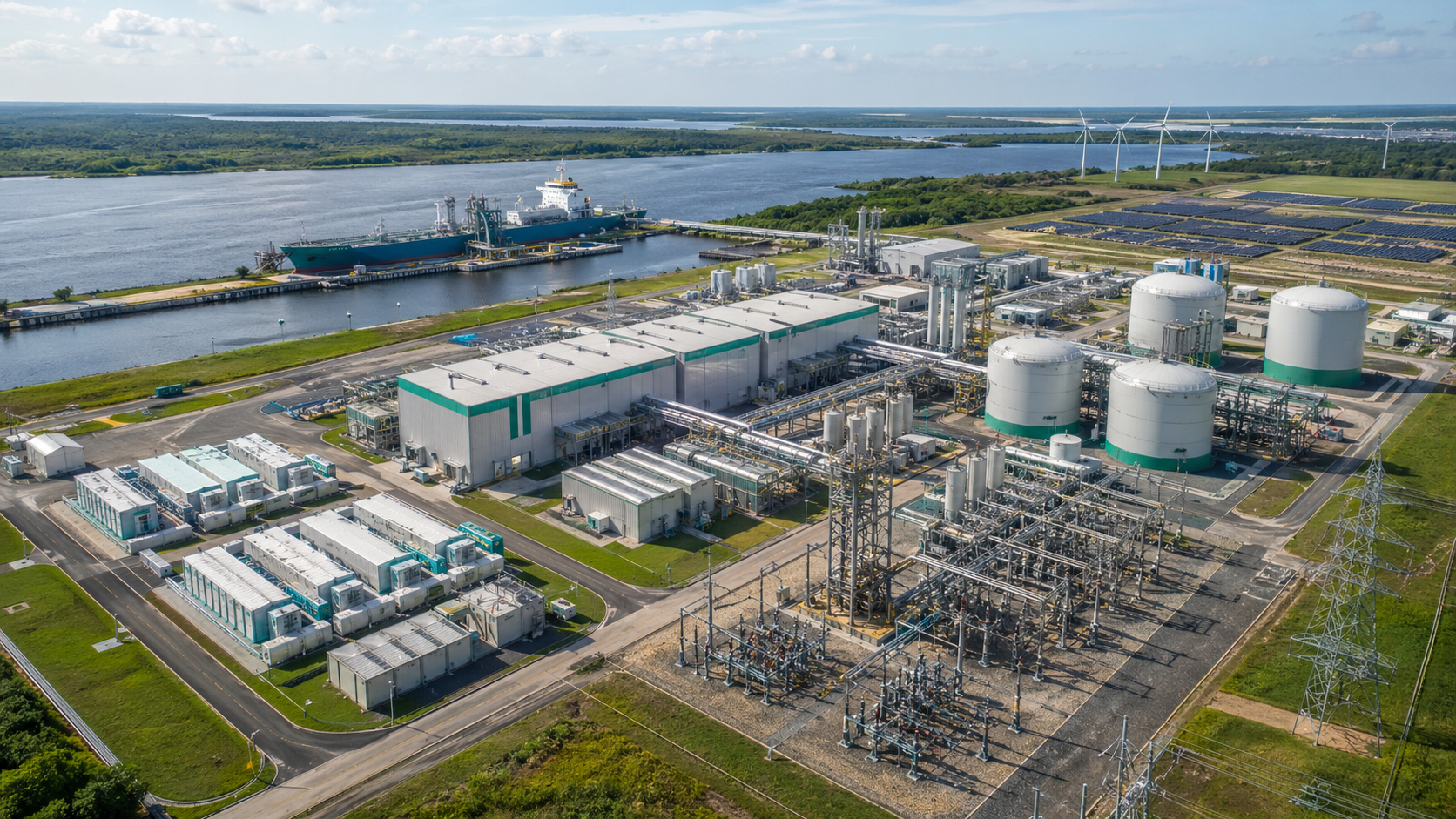
ATOME is developing a low-emission fertilizer plant in Villeta based on green hydrogen. Publicly verifiable information places the project near the Paraguay River logistics corridor and links it to international financing confirmed in 2026.
This brief focuses on what can currently be traced to primary sources: announced investment, location, construction phase, and probable technical profiles. Employment figures should be read as project scope, not as immediate vacancies.
Professionals preparing for this segment should focus on industrial process engineering, power systems, plant safety, and technical English. Timelines should be checked against project communications before being treated as final.
ATOME Green Hydrogen and Ammonia Facility
Project Overview
The ATOME PLC green hydrogen and ammonia production facility in Villeta, Departamento Central, Paraguay, is among the more significant announced renewable industrial chemistry projects in South America. ATOME PLC, a London-listed company, reported a project investment of USD 665 million (approximately Gs. 4.85 trillion) for what is structured as a phased development: Phase 1 construction is announced to begin in 2026, with operations targeted for 2028. These timelines are planning objectives and should be assessed against reported construction progress as the project advances.
The project’s multilateral financial backing — which includes the International Finance Corporation (IFC) and the European Investment Bank (EIB) — provides a degree of institutional validation consistent with projects that have completed significant environmental, technical, and financial due diligence. For international professionals evaluating the project’s credibility, multilateral lender co-financing is a materially positive indicator, though it does not guarantee timelines or ultimate project completion.
ATOME’s partners for the project include Yara International ASA, the Norwegian fertilizer company and one of the world’s largest producers of ammonia-based agricultural inputs, which has announced an offtake agreement for the facility’s green ammonia output. Process technology is provided by Casale S.A., a Swiss engineering company specializing in ammonia and urea synthesis. This consortium structure — combining a project developer, an established off-taker, and a specialized process licensor — is the standard architecture for greenfield industrial chemistry projects at this scale.
Technology Context
The Villeta facility is structured around a green hydrogen-to-ammonia production chain. Understanding the process is relevant to professionals evaluating whether their technical background is applicable.
Green hydrogen (H₂) is produced through water electrolysis powered by renewable electricity. In ATOME’s case, the electricity source is Paraguay’s surplus hydroelectric generation from the Itaipú Binacional dam — a critical input that differentiates this project from green hydrogen facilities powered by solar or wind, which face intermittency challenges. Continuous, low-cost, renewable electricity is the foundational competitive advantage of the Villeta site.
The hydrogen produced by electrolysis is then combined with nitrogen (extracted from air through an air separation unit) in an ammonia synthesis loop (the Haber-Bosch process, as optimized by Casale’s proprietary technology) to produce green ammonia (NH₃). Green ammonia can serve directly as a fertilizer feedstock — the application relevant to Yara’s offtake position — or as a hydrogen carrier for transport and eventual reconversion to hydrogen in destination markets.
This production chain positions ATOME’s facility within the broader global effort to decarbonize agricultural inputs, where conventional ammonia production via steam methane reforming accounts for approximately 1 to 2 percent of global carbon dioxide (CO₂) emissions. The economic logic of producing green ammonia in Paraguay and exporting it via the Paraguay River to oceangoing vessels reflects the combination of low electricity cost, water availability, and access to the Paraguay-Paraná Hidrovía waterway.
Paraguay’s Competitive Advantage
Villeta’s position on the Paraguay River, approximately 30 kilometers south of Asunción, provides direct access to the inland waterway system that connects to Atlantic export terminals. This logistics configuration — renewable power at the point of production, river barge transport to deep-water ports — is central to the project’s cost competitiveness against green hydrogen and ammonia projects in regions with higher electricity costs or more complex export logistics.
The Itaipú hydroelectric surplus is a structural feature of Paraguay’s energy market: the country consumes less than half of its allocated generation from the binational dam, and the residual capacity is sold to Brazil’s grid at regulated prices. This oversupply dynamic creates conditions for competitive industrial power purchase agreements that would be difficult to replicate in markets with tighter grid balance.
Law 7548/2025 (Paraguay’s Investment Promotion Law) provides the regulatory framework under which qualifying industrial investments may access fiscal incentives including customs exemptions on capital equipment and raw materials, profit remittance flexibility, and legal stability provisions. ATOME’s project, given its scale and multilateral backing, would be expected to engage with this framework; professionals should verify specific applicability with qualified Paraguayan legal counsel.
Employment and Professional Roles
ATOME and its financing partners have reported construction employment of approximately 1,265 direct jobs, with total direct and indirect employment across the project lifecycle estimated at more than 5,000 positions. These figures are from ATOME, IFC, and EIB communications and represent projected ranges rather than confirmed hire counts. The composition by skill category has not been published at a level of granularity useful for individual career planning.
Engineering Disciplines
Hydrogen process engineers with experience in electrolysis systems — particularly alkaline electrolysis (AEL) or proton exchange membrane (PEM) electrolysis at industrial scale — represent a global shortage category, and this profile is not currently available in meaningful numbers within Paraguay’s domestic labor market. Process engineers with prior ammonia plant experience (Haber-Bosch synthesis, including Casale-designed systems) are similarly specialized.
Electrical engineers and power systems specialists with experience in large-scale variable-load integration, particularly connecting multi-megawatt electrolysis loads to grid-tied systems, are relevant during both construction commissioning and operations. Industrial electricians with high-voltage experience and certification relevant to large industrial installations are required during construction.
Environmental and Compliance Roles
Environmental, Social, and Governance (ESG) analysts and environmental engineers with experience in IFC Performance Standards compliance and EIB environmental policy requirements will be necessary for sustained monitoring and reporting obligations attached to multilateral financing. This is a less visible but stable category of demand throughout the project’s operational life.
Construction project managers with prior experience managing large-scale process plant construction — including greenfield chemical or fertilizer facilities — are relevant in the 2026–2028 construction and commissioning window.
What International Professionals Should Know
ATOME’s facility is at an earlier stage of construction realization than, for example, Paracel, which commenced physical construction in 2023. The 2026 construction start and 2028 operations target represent a planning schedule; professionals considering relocation to Paraguay specifically for this project should monitor construction commencement announcements before making binding decisions.
As with all large project employment in Paraguay, direct hiring by ATOME PLC for most construction roles is unlikely. EPC contractors engaged by ATOME for civil, mechanical, and electrical work will be the primary hiring vehicles for most technical positions. Monitoring industry procurement announcements, particularly through ATOME’s investor relations communications and Paraguayan press, is the most practical monitoring approach.
The project site in Villeta is within practical commuting distance of Asunción, which provides access to the capital’s international schools, healthcare facilities, and expatriate professional networks. For professionals with families, this proximity is a materially different situation from, for example, the Paracel site in Concepción, which requires either long-term relocation to a smaller city or a commute schedule.
Data Note
The USD 665 million investment figure is reported in ATOME PLC investor communications and multilateral lender documentation; it has not been independently verified for this publication and should be treated as announced. Project construction timelines — 2026 start and 2028 operations target — are planning objectives disclosed in corporate and lender communications and are subject to contractor procurement, regulatory approvals, and construction progress.
Employment figures of 1,265 direct construction jobs and 5,000+ total direct and indirect jobs are per ATOME, IFC, and EIB communications. These are projections across the project’s full lifecycle and do not indicate the number of vacancies open at any given time. No verified active vacancies were confirmed at the time of writing.
Information current to early 2026. Investment and employment figures are announced per project developer and multilateral lender communications. This page does not constitute legal, tax, or employment advice.